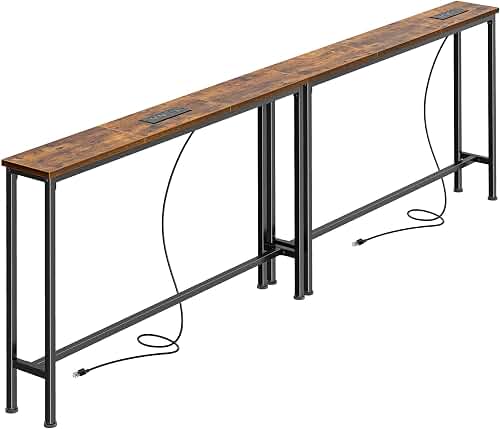
Specifications
| SUPERJARE 78.8" Narrow Console | HOOBRO 29.5" Narrow Console | HOOBRO 29.5" with 2 Fabric Drawers | SUPERJARE Rattan Console | MAHANCRIS 43.7" Console | Huuger 41.3" Modern Console | |
|---|---|---|---|---|---|---|
| Price | $54.99 | $28.48 | $39.98 | $98.99 | $40.99 | $94.99 |
| Length | 78.8" (two 39.4" tables combined) | 29.5" | 29.5" | Not stated | 43.7" | 41.3" |
| Depth | 5.7" | 9.5" | 9.4" | Not stated | Not stated | Not stated |
| Height | Not stated | 29.5" | 29.5" | Not stated | Not stated | Not stated |
| Outlets | 2 AC, 1 USB, 1 Type-C | None | None | 2 AC, 1 USB, 1 USB-C | 2 outlets, 2 USB, 59" cord | None |
| Storage | Not stated | Wooden shelves | 2 mesh shelves + 2 fabric drawers | 3 drawers + open shelf | Display shelf | 2 shelves + open bottom |
| Weight capacity | Not stated | Not stated | Top 88 lb, each mesh shelf 33 lb | Not stated | Not stated | Not stated |
| Adjustable feet | Not stated | Yes (4) | Yes (4) | Not stated | Yes | Yes |
| Anti-tip kit | Not stated | Not stated | Not stated | Not stated | Yes | Not stated |
| Finish | Rustic brown | Rustic brown / black | Rustic brown / black | Synthetic rattan, natural | Rustic brown / black | Rustic brown |
Quick answer: Decorate a console table in three zones — a tall anchor on one side (lamp, mirror, or art leaned against the wall), a mid-height cluster in the middle (books, a bowl, a small plant), and negative space you deliberately leave empty. Then solve the boring part first: pick a table whose depth actually fits your walkway, and if it's living behind a sofa, get one with outlets so the lamp cord isn't crossing the floor. Everything below assumes the styling only works if the table itself is the right size.
Most console-table advice skips the part that ruins it. You buy a table, you style it beautifully, and then you discover it's 15 inches deep in a hallway that's 32 inches wide, or the lamp you put on it needs an extension cord snaking across the rug. Depth and power are the two decisions that determine whether the styling survives real life.
The three-zone rule
Divide the tabletop into thirds visually. Tall zone: one item at roughly 2/3 the height of whatever is above it — a slim lamp, a stack of art, a vase with branches. Mid zone: a horizontal stack (two or three books laid flat) topped with something small and round — a bowl, a candle, a ceramic object. Empty zone: genuinely empty, or holding one low tray for keys. That third zone is the one people fill in and immediately regret.
Finding the right how to decorate console table comes down to matching the features to how you will actually use it.
If your table sits behind a sofa (a "sofa table"), lower everything. Nothing should break the sofa back line by more than a few inches except a lamp, or you're looking at the underside of a vase all evening.
Start with the depth problem
The single most useful number is depth, and it's the one nobody checks. In a hallway, subtract the table depth from the hallway width and make sure you're left with at least 30 inches of walking room. Behind a sofa against a wall, measure the actual gap — it's usually between 4 and 10 inches, and a 15-inch table simply will not go there.
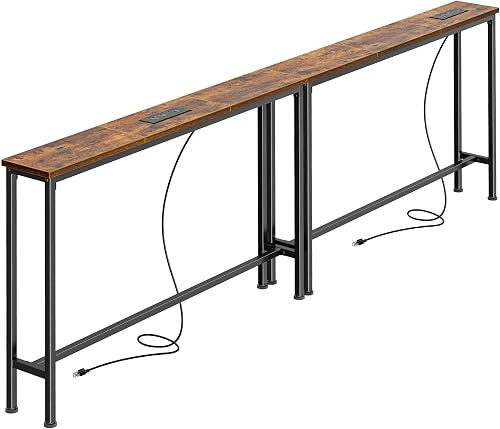
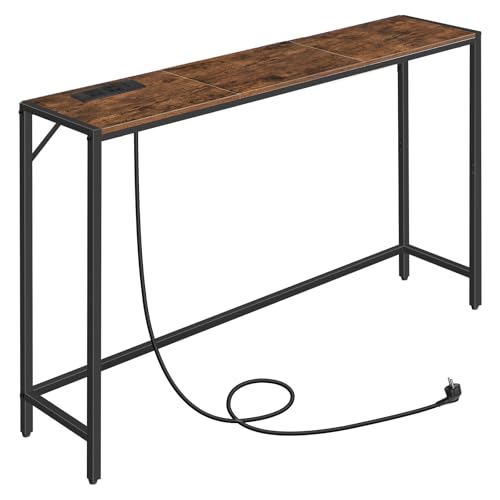
That gap case is what the SUPERJARE 78.8 inch Narrow Console Table with Outlet, Sofa Tables, Behind Couch Table, Long Entryway Tables with Charging Station, for Living Room, Rustic Brown is built around. At 5.7 inches deep it's designed to slot into the awkward space between a sectional and the wall or a windowsill, and the 78.8-inch total length comes from combining two 39.4-inch tables — which also means you get to choose whether the charging station lands in the middle or off to one side. It carries 2 AC outlets, a USB port and a Type-C port, so a lamp and two phones can live there without a cord crossing the floor. The tabletop is made of three panels on engineered wood with a metal frame.
At 5.7 inches, though, your styling vocabulary shrinks. A slim lamp, a small basket, a remote, a drink — that's roughly the listed use case, and it's honest about it. Wide bowls and deep vases will overhang.
Who this styling approach is for
- You have a real console or sofa table with a defined wall or sofa behind it, giving you a backdrop to layer against.
- You want the table to work — keys, chargers, mail — not just look styled in photos.
- You're willing to leave a third of the surface empty. This is the hard part.
- You have a lamp or a mirror to act as the tall anchor. Without vertical height, a console table reads as a shelf.
Who should skip it
- Very narrow tables under about 6 inches deep. Three-zone styling needs footprint. On a 5.7-inch surface you're doing a lamp and one small object, and that's the whole design.
- Tables in high-traffic pinch points. If people brush past it daily, decorative objects become floor objects. Use a tray and nothing else.
- Homes with toddlers or large dogs. Skip the tall anchor entirely, or use only wall-mounted art above the table and keep the surface to a low tray. If you're buying new, prioritize a model that ships with an anti-tip kit.
- Renters who can't put holes in walls. Leaned art works, but you need enough depth for the frame to lean without tipping, which most narrow tables don't have.
Honest trade-offs
Outlets versus price and looks. Built-in power is genuinely the difference between a usable sofa table and a decorative one — but it means a cord running from the table to a wall socket somewhere, and it narrows your options. Tables without power cost less and give you more shape choices.
Storage versus visual lightness. Drawers and fabric bins hide clutter, which makes the styled surface easier to keep clean. They also make the table read heavier and more solid. Open-shelf tables look airier but every object on the lower shelf becomes part of the composition — you can't hide anything.
Length versus proportion. A console behind a sofa generally looks right when it's shorter than the sofa. Long tables give you room for the three-zone layout; short ones force you to pick two zones and commit.
Engineered wood and particleboard. Several of these use particleboard or engineered wood. That's normal at this price and fine for lamps, books and décor. Don't plan on a heavy stone sculpture, and check the stated weight capacity where one is given.
What to check on the listing before you buy
Listings change, so verify these yourself rather than trusting any article, including this one:
- Current price. Every figure here is a snapshot. Confirm it on the page.
- The variant you're clicking. Colour, length and drawer configuration often share one listing. The price shown may belong to a different variant than the one pictured.
- Full dimensions, especially depth. Measure your gap or hallway first, then check the listing's dimension block.
- Warranty and return window. Confirm what the seller states and whether returns cover assembled furniture.
- Reviews and posted photos. Go read them yourself — buyer photos in real rooms tell you more about scale and finish than any product shot.
- Whether an anti-tip kit is included if the table will be near children or pets.
Alternatives worth considering
HOOBRO Narrow Console Table, 29.5" Small Entryway Table — consider instead if…
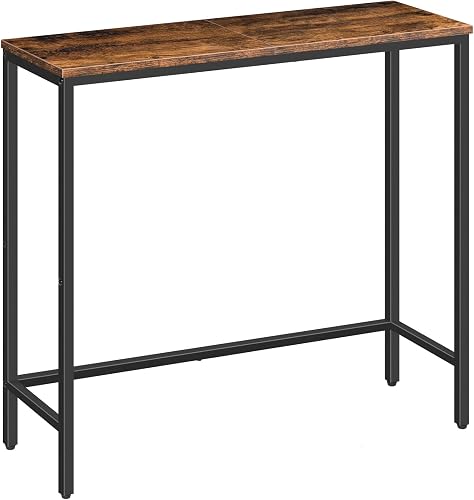
…you want the cheapest entry point and don't need power at the table. The HOOBRO Narrow Console Table, 29.5" Small Entryway Table, Thin Sofa Side Display Table, for Hallway, Bedroom, Living Room, Foyer, Rustic Brown and Black BF75XG01 measures 29.5"L x 9.5"W x 29.5"H — that 9.5-inch depth is enough for actual three-zone styling, unlike the ultra-slim options. Black metal frame, rustic brown wood panels, particleboard top and shelves, four adjustable feet. The listing notes you can place two together for a longer run, which is a cheap way to get length in a hallway.
HOOBRO 29.5" Narrow Console Table with 2 Fabric Drawers — consider instead if…
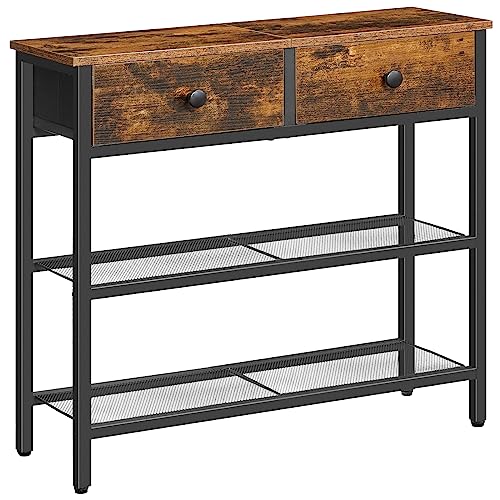
…your problem is clutter, not surface area. The HOOBRO 29.5" Narrow Console Table with 2 Fabric Drawers, Sofa Table, Small Entryway Table with 3-Tier Storage Shelves, Behind Couch Table, for Living Room, Hallway, Rustic Brown and Black BF72XG01 is the same 29.5"L x 9.4"W x 29.5"H footprint but adds two mesh shelves and two non-woven fabric drawers. The stated capacities — 88 lb on the top, 33 lb per mesh shelf — are the most specific numbers in this group. Drawers mean the mail and chargers disappear, which is what actually keeps a styled surface styled.
SUPERJARE Rattan Console Sofa Table — consider instead if…
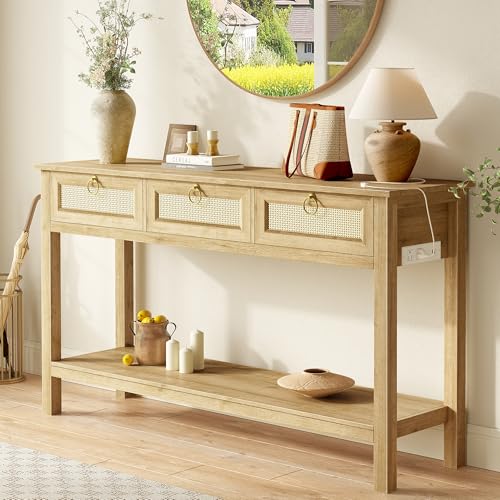
…you want the table itself to be the decoration. The SUPERJARE Rattan Console Sofa Table with Outlets and USB-C Port, 3 Drawer Entryway Table with Synthetic Rattan Surface, Open Shelf, Behind Couch Entry Foyer Hallway Storage, Natural pairs synthetic rattan with light oak tones and includes 2 AC outlets, a USB and a USB-C port on the side so the ports don't break up the front. Three drawers with smooth glides and anti-fall stoppers, plus a bottom open shelf for baskets, and raised legs so a robot vacuum can pass underneath. The top is water-resistant and wipes clean. It's the most expensive option here at $98.99.
MAHANCRIS Console Table, 43.7" Entrance Table with Power Station — consider instead if…
…you want power and length without the top-end price. The MAHANCRIS Console Table, Narrow Sofa Table, 43.7" Entrance Table with Power Station, Behind Couch Table, Simple Style, for Living Room, Hallway, Entryway, Foyer, Rustic Brown and Black CTHR112E01 runs 43.7 inches with a power station of 2 outlets, 2 USB ports and a 59-inch cord — that cord length matters more than people expect when the nearest socket is behind the sofa. Iron metal and engineered wood with a triangular brace under the top, adjustable feet, and an anti-tip kit included, which makes it the pick if small children are in the picture.
Huuger Modern Console Table, 41.3 Inch Sofa Table — consider instead if…
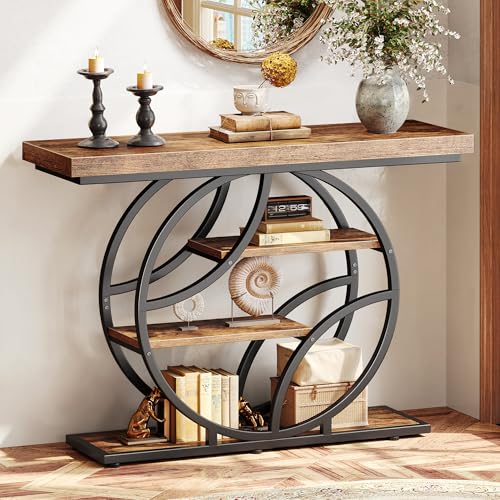
…you'd rather the frame do the design work than the objects on top. The Huuger Modern Console Table, 41.3 Inch Sofa Table with Artistic Curved Metal Frame, Narrow Entryway Table for Hallway, Living Room, Behind Couch, Rustic Brown uses a matte black O-shaped metal frame against a vintage woodgrain finish, with a 4cm-thick particleboard top that's water-resistant, scratch-resistant and easy to clean. Two built-in shelves plus open bottom space for baskets, adjustable feet, and 41.3 inches of length. No outlets — this is the one where you're buying the look.
FAQ
How high should a sofa table be relative to the couch? Aim for level with or slightly below the sofa back. If the table is taller, everything on it is visible from the seating side and the room feels closed in. Measure your sofa back height before you shop, not after.
How many objects belong on a console table? Three to five groupings, odd numbers, with varied heights. If you can't name what each object is doing — anchoring, adding texture, holding keys — it's filler and it goes.
Do I need a lamp on it? Not strictly, but a lamp is the easiest way to get vertical height plus a practical reason for the table to exist. If you want one behind a sofa, a table with built-in outlets saves you from a visible extension cord.
Can I put two short console tables together to fake a long one? Yes — a couple of these listings explicitly mention combining units for more length and storage. Buy the same model twice so the heights match exactly, and check whether combining changes where any charging ports end up.
Related guides
- Comparing Your Best home decor and accent furnishings - area rugs, floor lamps, wall art, coffee tables, console tables, end tables, accent tables, blackout curtains Options
- How to Style a Coffee Table Without It Looking Staged
- About Snugaria: Our Editorial Team and Research Standards
Key Takeaways
- Choosing the right how to decorate console table means matching the key features to your specific needs and budget
- Read real customer reviews and check the return policy before you commit
- Compare value across models — the priciest option is not always the best fit